Everyone is talking about the death of retail, but one giant stands apart: Costco. With an incredible 88% membership renewal rate, they are one of the best-run retailers on the planet. How do they do it? It comes down to their personnel, their dedication to member value, and their unique, lean business model. But for brand owners, the big question is: how do you get your product into a warehouse with only 4,500 SKUs? In this post, we reveal the insider secrets on what Costco buyers are really looking for, from offering 20% value to the three non-negotiable product requirements that determine if you get a quick ‘yes’ or a quick ‘pass.’ Learn how to navigate the test phase and structure your business for success with the retail giant.
Love the show? Subscribe, rate, review, and share!
Here’s How »
Join the On The Shelf community today:
- Ontheshelfnow.com
- On The Shelf Now Facebook Group
- On the Shelf Now Facebook
- On The Shelf Now Twitter/X
- On the Shelf Now Instagram
—
Listen to the podcast here
The Costco Advantage: Why It’s Retail’s Future And The 3 Keys To Selling Your Product There
It’s another day and another day getting into retail. I have a lot going on now. Not everything that we can talk about, but a lot of cool stuff. A lot of initiatives are going on with Costco, which prompted me to talk about Costco. A lot of you want to get into Costco. A lot of you are thinking about your products on the shelf or palette at Costco. There’s some key things that would be helpful for you to know before, during or after you make that initial inquiry into getting your products in there. Whether it’s roadshow, online, online roadshow, in warehouse, a test or not a test or coming from overseas or not. There’s a lot of moving parts to go into doing business with Costco just like any other retailer.
The one thing that makes Costco interesting is that they’re just so well run. To me, they’re one of the best run retailers on the planet. There’s two reasons. It’s personnel and it’s how they treat their members. Let’s start with personnel real quick. This is just from my experience. I don’t have any access to the internal working of Costco. I don’t have lunch with the CEO. I’m not hanging out with the executives there and they’re telling me the inner workings of the company.
Costco’s Highly Experienced And Long-Tenured Buyers
I’ve been doing business with them for more than seventeen years. One of the things I have noticed is they don’t hire anybody into big roles. Which means when you’re working with the buyer at Costco, that person has been at Costco for a long time. Probably more than ten years. They most likely started working with Costco in a warehouse, then they moved into the office. Became what’s called an inventory control specialist. At some point, years later, they were promoted to assistant buyer and hung out in that position for a long time before they became a category buyer.
When you’re working with the buyers at Costco, they know what they’re doing. They know what they’re talking about. If they tell you, “I don’t think that products are going to do well.” Most likely that’s based on experience over the last X amount of years. They’ve tried it. They’ve done it. They’ve looked at it and it just hasn’t worked. They know their category. Costco is also very strict on what their buyers can and cannot do. Therefore, they’re able to stay in position for long periods of time. Unlike other retailers that keep swapping out their buyers consistently and you can’t get any continuity.
When you’re working with Costco buyers, they know what they’re doing—and they know what they’re talking about. Click To TweetIt’s a benefit that they’ve been around a long time. It’s a benefit that they can tell no quickly rather than dragging it out. I know sometimes if you’re taking a product to them and they say they’re going to pass. It’s so disappointing. I’ve taken hundreds of products to Costco and they have passed on the majority of them. It’s always a quick pass, which I love. It makes it so that I don’t have to keep coming back. I don’t have to keep trying to find out, “What’s going on? What do you think? Can you give me an answer?”
They’re generally pretty quick because they know. Also, the warehouse personnel. When you’re in a Costco, those people know their job. They’re very efficient. They’re pretty happy and get treated well. They make good money and have benefits. They have ownership. If you want to see a retailer or where their employees take ownership, go spend some time in a Costco. Not a lot of management out there is trying to crack a whip. They’re out there and everybody’s doing their job. Everybody knows what they should be doing. Everybody’s helpful.
If you guys have listened to any of my YouTube shorts lately or read any of my Substack posts. You’ll know that I’ve had some experiences lately where employees haven’t been helpful. I was at Lowe’s and a product had a UPC. The checkout person made it look like, “First of all, it was my fault. Secondly, I was the one who had to fix it.” Not, “Let me get a manager for you. Let me find that in the catalog. Let me take care of you.” No. You want to buy that? You need to go fix it. You need to go find it. You need to go get one off the shelf and bring it up here so I can ring it up.
You’re not going to find that at Costco. That’s not what’s going to happen. Also, Costco’s generally don’t look bad on the inside. They don’t look sold through. They are constantly restocking, constantly bringing stuff out to the floor, and constantly moving things around. One of the cool things about that is because they don’t have that much product. On average, they have about 4,000 to 4500 SKUs compared to 50,000 to 60,000 SKUs at a Target up to even more than that. A lot less for them to move around. They’re all moving it around on pallets, which is super smart. It makes it easier.
It makes it more convenient. You don’t have to wonder what olive oil you need to get at Costco. They only have one. You can bet it’s probably good. You’re not wandering, “There’s seventeen olive oils here. What should I do? What should I get?” There’s one palette and that’s it. Most likely, there’s somebody at the end of the aisle that’s tasting it out. You can try it on a cracker. As you can tell, for me, it’s pretty enjoyable.
Do I always get products into Costco? No. I have a couple there. I’m doing well, but the majority of the time I get the no. I get the, “I’ll pass,” but I don’t let that bother me. It doesn’t mean no forever. It only means no for now. The more I respect their decision, the easier it is for me to come back again with a different product. The more they hound them and cry about it like, “What do you mean? What are you saying? Why are you talking that way?” The less they’re going to want to deal with me the next time I bring them something.
All cool things for you to keep in mind. A lot of times, people say, “Is retail dying? What’s retail going to look like in ten years?” I don’t know the answer to that. A lot of things have to change in order for retail to continue in its same way. Costco is going to be around in ten years because they offer value. They have great customer service. They’re people are happy and they’ve been around for a long time. They know their job. They know how to do it. They’re efficient and fast. They’re fairly easy to work with. There you go.

How do you get in there? That’s a great question. A lot of people ask that all the time. Is it somebody that you know? No. I will tell you this. Does it make it easier if you know the person who’s the buyer? Maybe. Only in that you can reach out to that person and say, “Would you take a look at this product?” That’s going to be faster than if you’re reaching out blind, for sure. For instance, somebody brings me a product in a category that I’m doing business in. It’s fairly easy for me to reach out to the buyer that I’m talking to generally on a weekly basis to say, “I have this other product. Can you take a quick look?”
That’s easier than if I’ve never spoken to that buyer and I’m reaching out cold. Asking them to take a look. Does it mean that I’m going to get a yes because we know each other or because we work together on a different product? Absolutely not. The product has to stand on its own. I need you guys to stop thinking that because somebody has some relationship that’s magically going to get your product into Costco or into any retailer. It’s not.
I had somebody say, “I was hoping that you had these relationships.” What relationship are you talking about? What magic relationship are you thinking that I have that I can call and leverage some buyer and say, “Why don’t you put $300,000 into this product just because I said?” Sorry guys, that doesn’t exist. If somebody out there is telling you that it does, I wouldn’t go so much just to tell them they’re lying. I would be very suspect as to the validity of that. I’ve been in the business for about 30 years.
I’ve been in it so long that I remember when the big companies were paying. People were taking kickbacks. People were going on vacations and getting limos. That’s how you could get products in. Back then, it made it very difficult for the people that are my clients to get their products in. They simply did not have the funds that were needed to get buyers to look their way. That’s all gone now. That doesn’t exist anymore. Buyers aren’t able to do that. They were never allowed to do it, but it just wasn’t that monitored.
The Myth Of Relationships Versus Understanding The Costco Business Model
These days, you can’t even send a buyer at Costco some candies for Christmas. They’re going to donate those. Don’t do it. If you’re trying to sell the Army Navy Exchange. You can’t even offer those guys water. They’re like, “I can’t take that.” “Bro, it’s water.” I know that’s a little bit of a tangent, but it’s not about relationships guys. Relationships might make your connection with them faster. If we’re going to talk about Costco in general, what’s going to make the difference is your understanding of the Costco business model, how it works and does your product fit in it.
If you take your product to Costco, they are going to assume that you understand what they do. They’re going to assume that you understand how Costco does business. They’re going to assume that you understand what you’re getting into. They’re not going to test you on it. They’re not going to say, “Before we go down this road, do you guys get this? Do you get that? Do you understand this? Do you understand that?”
Key Product Requirements: General Appeal, Easy Explainability, And 20% Value
They’re not going to do that. They’re going to assume that you know that. If you don’t, you better get a hold of somebody who does and can run your product through their model so that you can see if it fits. You can see if there’s enough money in there. You can see if you’re able to manage that volume. You can check all those things. Number one, how do you get your products into Costco? You got to make sure that your product is right for Costco. There’s a couple ways to do that.
Number one, your product has to be more general and less niche. I always use this example because it’s very extreme. Let’s say you make a college level beer pong table and you want to sell that to Costco. First of all, Costco’s not going to sell beer pong tables. Sorry, just to get that right out there. Secondly, even if they did sell drinking games, that’s pretty niche. Not everybody that comes into Costco and walks by that would buy it or even be able to buy it.
Every product at Costco should be able to be purchased by every member that walks by it. Not that they would buy it, but they should be able to buy it, meaning a latter. Every person that walks through Costco could at some time use the latter. Not that they need it now but they could like water. Everybody drinks water. Everybody could buy that. Not that they need it, but they could. Also, toilet paper. It’s those kinds of things. If your product can’t be bought by everybody, it can only be bought by a small niche audience. It’s not right for Costco. It can’t be one of their small 4,500 SKUs. It just can’t. It might be okay for Costco.com. That might be another opportunity for it, but it’s not going to make it into the warehouse.
Every product at Costco should be something that any member walking by it can afford to purchase. Click To TweetNumber two, for your product. Do people get it pretty easily? Your products are going to be on a pallet. It’s going to be displayed. Either stacked on a pallet or a tray on a pallet. People are going to walk by it. Thirty thousand members a week on average are going to walk by it. Can they get it right away? It used to be that Costco sold these faked out pallets. The bottom half of the pallet was all marketing and the top half of the pallet was the product. Not anymore. The whole pallet is the product.
You have to be able to explain your product pretty fast to the member for them to get it in and understand whether they need to put it in their cart or not. If it takes you five minutes to explain your product to me. You probably can’t explain it to a member quick enough for them to get it. Now, that doesn’t mean that you couldn’t do Costco Roadshow. If you don’t know what Costco Roadshow, that’s like having a trade show inside Costco where you have a salesperson. That person can explain it. That might be an opportunity for you.
Costco online might be an opportunity where you can spend time and use videos, use copy and take a little extra time to explain it. On a pallet, both doubting Costco, they need to be able to walk by and go, “I know exactly. That’s a flash drive. That’s one of the new flash drives. I get 20 for $9.99? I need that.” It’s pretty easy in that way. 1) Is your product available to everybody? 2) Is it easily explainable? 3) Are you able to add value to it? Your product needs to be on average 20% value to the market that you’re selling it to.
Wherever else you’re selling it, at Costco, it’s going to be a 20% value. That value is either going to come in money off or it’s going to come in value in the box. One of those two things, can you sustain a 20% value either off of the price or 20% more value of stuff in the box for the same price that you sell it elsewhere? Value is what makes the wheel go round at Costco. They protect their member value like it’s their most precious secret. If you’re not able to offer value or enough value, you’re going to struggle or you’re going to get, “We’re going to pass.”
Those are just a few of the product things that you need to take into account. Product things are so analytical. Those are a couple of the key things about your product that come to my mind right away. I have people bring stuff to me all the time and want to go to Costco. A lot of times, those are the quick three things I look at margin wise because Costco doesn’t take a lot of margin. It’s on average about 14% or less.
A lot of times brands think, “I have so much margin.” You don’t. Program costs or something that you got to take into account at Costco because you’re going to have to market your product. You’re going to have to promote your product. At the end of the quarter, you’re going to have to market down and get rid of it unless it’s probably a food item that’s there all year long. Let’s say you’re selling beach chairs, for instance. Those are going to go in probably April or May and they’re going to leave in August.
They’re not going to be able to be in the warehouse after August. They’re all going to be marked down. You have to have money in your budget for that ahead of time. You got to have that built in. A couple of things to think about your product. If you want to run by your products and see whether you think we think it’s right for Costco. Feel free to reach out. I’m happy to look at it and work with you on that.
Next, you’re going to want to look at how you can merchandise it. Is your product able to be easily merchandised on a pallet? How does it fit? How expensive is it? How much money would Costco have to pay for a pallet? Is it a kayak? Is it a table? How are you going to get it there? Where is it coming from? You’re going to want to try to figure that out before you send it to Costco. Most likely, within your pitch that you made at Costco, you’re going to want to show them at least a mocked up version of what the pallet display would look like if you were to get in.
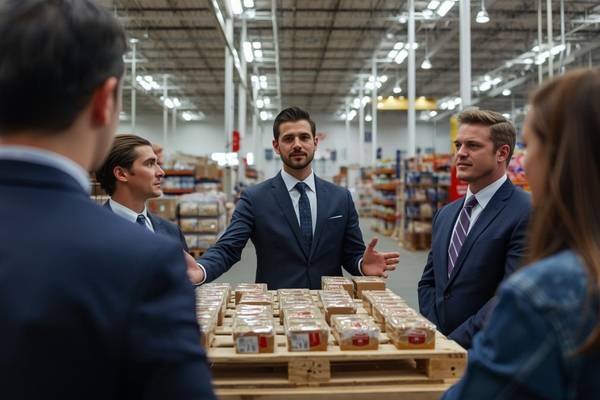
It’s not going to be perfect. They’re going to want to make changes. At least you can show them. “It does fit on a palette. It can be merchandised so that people can see it from all sides.” Remember that the pallet shouldn’t be taller than six feet when it’s all said and done. You’re going to want to have some pallet display mocked up for them. For pricing, when you’re going to Costco, you’re only going to talk to them about the price that you’re able to offer to them at. Not what they’re going to retail it at. That’s none of your business. They don’t want you to tell them what to retail at.
In fact, if you tell them, they’re going to tell you right back, “We’ll decide what the retail is.” All you’re giving them is their cost. Now, that doesn’t mean that you can’t extrapolate what their cost is by taking a look at quickly, “If your product sells at retail for $10, Costco’s going to retail for $8 and then you take 14% off of that. You’re able to give them their costs. You can back into their cost and dictate what they would retail it out by doing it that way. You just don’t tell them, “Here’s your cost. Here’s our suggested retail for Costco.” They’re not going to like that.
They’re going to hit you right back with, “Don’t tell us what we’re going to retail at.” You just say, “Here’s the cost at Costco.” You don’t necessarily have to tell them. Don’t necessarily do their work for them. Don’t tell them, “This is at this value. We’re giving you 33% value of the market.” You don’t need to do that. They’re going to figure that out. They’re going to run the numbers. If there’s not enough value, they’re going to come back and tell you but you don’t need to tell them what the value is. Let them do a little bit of work. Let them do a little bit of research.
I will tell you this. They’re going to look at the lowest price they can find your product. Whatever the lowest price they can find it online or anywhere in the market. That’s what they’re going to want their value off of. If your average price is, let’s say $99.99 but you have some random retailer out there selling your product for $89.99. That’s what they’re going to want to be a value off. Not the $99.99. If you have $99.99 on Amazon but you’re constantly having on sale for $89.99. They’re going to want a value off of $89.
Pricing Strategy And Protecting Value Against Market Discounting
If you have your product on sale on Amazon, I would take it off a sale when you’re pitching Costco. They’re looking at your product off of its main retail. Here’s the thing. If you get it in Costco and then you start discounting your product on Amazon. They will come back to you and say, “We’re going to need a different cost on this because you’re selling it for $89.99 on Amazon. Now we need to value off of that.” Remember what I told you, they protect that value. Members purchase memberships at Costco to get the value. They respect that so much that they’re going to fight for it. Now, they have an 88% renewal rate on their membership.
Who has a 88% renewal rate? Nobody. Costco does. They’re going to protect that. If you think you’re going to get it by them and you took it off a sale. Now you’re in Costco and you’re going to put it back on selling on Amazon to drive business. No. If you want to protect your Amazon business then sell Costco a with different version that can’t be comped on Amazon. One that has a different UPC. It has a different item number. It has different things inside it, so it can’t even be a comp on Amazon. Amazon can’t even look at it. It wouldn’t even calculate to them that these are the same things.
Who has an 88% renewal rate? Nobody—except Costco. And they’re going to protect that Click To TweetIn fact, that’s the best thing to do. You can run your Amazon business and your retail business. They can be separate. You’re not constantly messing up your retail business because you’re trying to manage your Amazon business up and down pricing, promotions, a prime day and all of those things. Let me tell you, retailers don’t care. They don’t care what your problems are. They don’t care that you need this or need that. They want what they want, when they want and how they want it. That’s just the way it goes.
They’re not going to be okay with you being like, “We’re putting our product on sale because we need to drive business on Amazon.” They’re like, “I need a better price.” Simple as that so that I can do it. By the way, retailers can’t change pricing lickety split. That takes time. It takes money. They got to pay employees to go out there, print signs and change pricing. It doesn’t happen overnight. In order for you to run your Amazon business and your retail business, I would try to have two separate products. I know we’re getting into a lot of weeds here. I wanted this to be like boom, boom, and boom. As I’m talking through it, things just come up. You know how I am. Things come into my head and I just say them.
If you want to sell your product to Costco, make sure that everybody at Costco can buy it. Make sure that it’s easily merchandisable. Make sure that it’s not niche. Make sure that you can withstand the margin and have money to promote it and money to market down. Make sure that you digitally mocked it up so it looks good in their model. Costco’s going to want to deliver the price. They’re going to want to know, “What’s my cost to get it to my DCs?” They may want to at some point pick it up from your factory.
Traceability, Pallet Requirements, And Budgeting For Returns
You may ask me, “Tim, do I have to tell him where my factory is or what my factory address is?” You do. They’re not going to sell your product without knowing where your factory is or where it comes from. That’s called traceability. They need to have visibility on where the products that they’re selling their members come from so that if there’s a problem, they can trace it back. You may not have to tell them where your factory is when you’re pitching them.
You don’t have to do that. You can tell, “It’s in China or it’s in Korea. It’s wherever.” You can tell them that, but you don’t have to give them your address when you’re in the pitching stage. Once you’re filling out item agreements and quoting them. You’re going to have to put in where your factory is. They’re going to need to know that in the end. When do you know if you’re in? Costco’s going to test your product, most likely, at least in the warehouse.
They’re not going to put it in a bunch of warehouses. They’re going to want to put it in probably 10 for 7 days. You’re most likely going to lose money on that order. The reason is it’s because you’re creating a smaller order for maybe just 10 pallets and 10 warehouses. You have to give it to them at the price that you told them for a much larger order. You’re most likely going to either breakeven or lose money on that. It’s just part of doing business.
They’re going to be looking that you can sell $500 for the product per week on average across all the warehouses that they put it in. Now, $500 doesn’t sound like that much, but it is. Depending on the price of your product. If you’re priced $100, you get to sell five a week. Again, that may be doesn’t sound like that much with 30,000 members going through there. I hope that’s true but that’s just the minimum. That’s the minimum for them to just say no right off the bat.
Once you get to the stage where you’re testing it, believe me, the Costco buyer wants to work. They want your product to do well. They didn’t go through all of this onboarding just so you could tank. They’re not hoping that you tank. Once you’re on board and testing in Costco, their reputation is on the line, too. They’ve put a lot of time and effort into this program and they want it to work. They’re going to do their best to help you and make sure that it’s a success if they can. They can’t force their members to buy it.

If you want to get your products into Costco, your first thing has to start with, “Do you understand how to do business with them? Do you understand what their business model is? How do they break down their pricing? What value do they need over the market? Are you able to sustain that value? Are you able to manage your pricing across all your different platforms? Do you have a product that is not niche and could be purchased by pretty much any member? Is it merchandisable? Can you palletize it? Do you have a factory that’s able to meet the Costco requirements as far as CHEP pallets and all the things that they require.
They use different pallets at Costco because that’s how they move the product around. It’s not like your product arrives on a palette and then they take the product off the pallet and toss the pallet into recycling. Your product lives on that pallet the entire time it’s in the Costco warehouse. It’s going to get moved a bunch of times. Sometimes nightly by forklifts. If it’s a chintzy pallet or not well-made. It’s going to break down and break. That’s going to cause a slowdown. They’re going to restock your product on a different pallet. They have pallet requirements.
Do you know what those are? Are you able to live within that? If you don’t have those, are you able to buy them? They also have a pallet. It’s a pallet exchange. You work with a company and you get pallets from them. When they’re done, Costco sends them back. You’re renting these pallets almost. Lastly, does the money work? Are you going to make money? It hasn’t happened for a while but I used to get calls from people all the time, “I’m in Costco, but I’m not making any money. I didn’t know I was going to mark my products down. I didn’t know that I was going to get charged for returns. I didn’t know Costco returned everything.”
You have to make sure that you have cruel money for returns so that you’re not getting blindsided by that. I’m happy to help as I said. If you want us to take a look at your product, if you want to reach out, you can go to the website, TLBConsulting.com. You can book a consultation with us. I’m happy to talk to you. There’s a couple different ways that you can connect with us. You can find us on Substack under @ShelfStrategy.
We have a great portfolio of articles there. You can find us on YouTube under TLB Consulting. We have a new retail accelerator Mastermind group, which is growing. It has a lot of great brand owners in there that are right along with you. They’re wanting to get their products into Costco and other retailers. Sometimes, it helps to be in a group full of people that are trying to do the same thing you are trying to do.
We go through a different series. We meet every week. Generally, it takes two months to get through each series. We’re in the series of what to do once you have the buyer’s interest. That’s what we’re covering, if that interests you. You’re like, “The buyer responded to my email. Now what?” How do you keep them interested? How do you keep that process moving? That’s what we’re covering. As always, I’m in your corner wanting you to do well and to be successful.
TLB Consulting started as a company helping people to get into retail, but we’ve evolved over the last eighteen years into a company that helps people be successful in retail. Even if you’re in retail and you’re wanting to accelerate that, give us a call. Thanks so much for reading. I appreciate it. Until then. I look forward to seeing your products on the shelf.